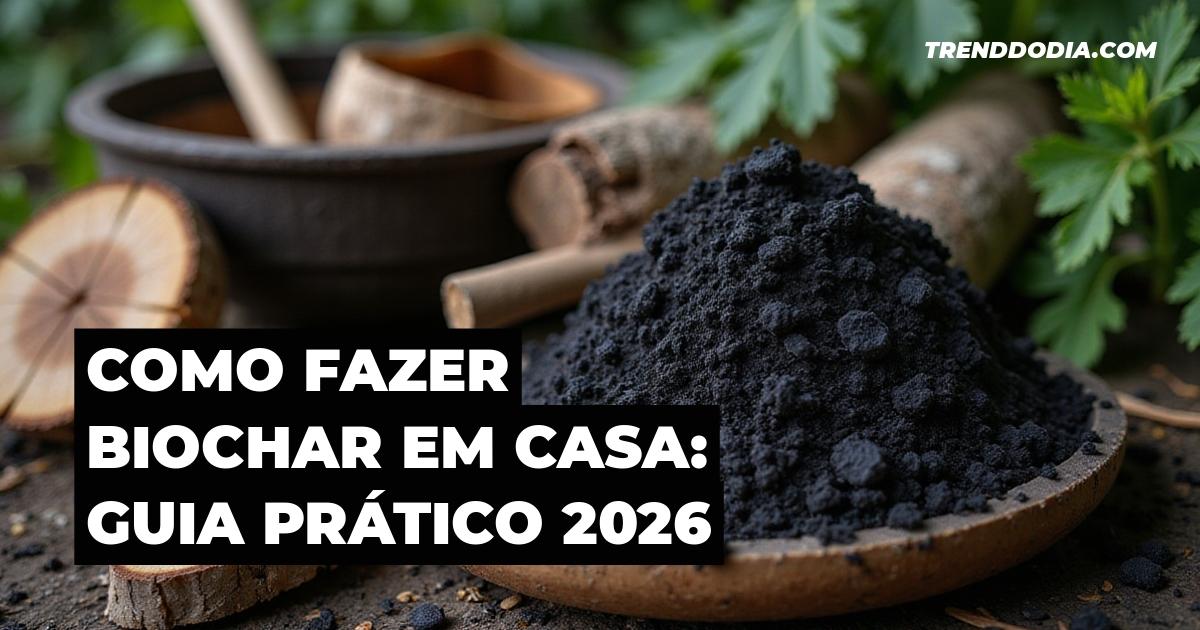
You can make biochar at home by burning plant waste, such as branches, prunings, and bark, with little oxygen in a hole or metal can. Just extinguish the fire at the right time, activate it with organic compost, and mix it into the garden soil to retain water and nutrients naturally.
With simple safety precautions and a clear step-by-step guide, you can reuse organic waste from your kitchen and garden, improve the health of your vegetable garden, and even help store carbon in the soil. Here's how to start from scratch without spending a lot on equipment.
What is biochar and why use it in your garden?
Biochar is a type of charcoal produced from plant waste through combustion with little oxygen, or pyrolysis, which is a natural process of thermal decomposition. This technique creates a porous material that, when added to the soil, helps retain water and nutrients for a long time.
For example, imagine a resident of an urban neighborhood in São Paulo who collects garden trimmings and transforms them into biochar to use in pots growing peppers and tomatoes. She notices that this makes the plants more resistant to drought, which is ideal for Brazilian tropical soils.
In this sense, researchers from Embrapa (2020) discovered that biochar can increase water retention in the soil by hundreds of liters per hectare. The point is that in small gardens, like those in your backyard, the effect is visible with less frequent watering.
Difference between biochar and regular charcoal
Biochar differs from regular charcoal because it is explicitly designed to improve the soil by soaking low-oxygen biomass to form microscopic pores. Typical charcoal for barbecues or fireplaces, on the other hand, does not undergo this controlled preparation and may contain toxic impurities.
For this reason, while biochar increases microbial life in the soil, common charcoal can inhibit root growth if used directly without proper activation.
Main benefits of biochar for Brazilian soils
Biochar offers benefits such as increased water and nutrient retention and reduced erosion in tropical soils, which are common in Brazil. It creates a favorable environment for beneficial bacteria, improving long-term fertility.
In addition to helping in the garden, biochar contributes to regenerative practices, as explained in the article. green manureThis makes your green space more sustainable and diverse in terms of biodiversity.
Materials, types of waste and safety precautions
To make biochar at home, you need simple materials like a shovel, buckets, water, and dry plant waste. Depending on the method, you can use a hole in the ground, a metal can, or even a small recycled barrel, without spending much.
For example, a resident in the interior of Minas Gerais uses eucalyptus pruning branches and garden waste, such as corn or beans, to produce biochar in an open area of their backyard. This type of waste is easy to find and makes the process accessible to anyone.
Well, studies by Epagri (2021) show that local agricultural waste, such as this, is an efficient source for producing biochar on small rural or urban properties. Thus, you transform something that would be waste into a useful material for the soil.
Therefore, start with composting the waste if you have a large volume, or use everything for biochar if it's a small amount. Don't forget to mix techniques, as the article explains. home composting It teaches how to make practical use of waste materials in composting.
Which waste products to use and which to avoid in biochar production?
Use dry plant waste, such as thin branches, fruit peels, corn husks, or bean stubble, which burn well and do not create pollutants. Avoid materials treated with chemicals, such as painted wood or printed paper, to prevent soil contamination.
For example, kitchen waste such as banana peels or green pumpkins also work, as long as they are dry. However, in these cases, discard any parts that are in advanced decomposition and could cause strong odors during burning.
Basic fire, smoke, and personal protection precautions.
For safety, perform the process outdoors, away from houses or flammable objects, and use gloves, a mask, and goggles to protect your skin, eyes, and lungs from the smoke. Always have a fire extinguisher or water nearby in case the fire gets out of control.
Additionally, light it carefully and monitor the smoke, which can be intense, to avoid disturbing neighbors. In apartments, opt for more controlled methods, such as a metal can, to minimize risks.
How to make biochar at home step by step
Making biochar at home is simple with two main methods: a hole in the ground or a metal can, which produce 1 to 5 kg per batch. The secret is to burn it slowly, covering it with soil to limit oxygen, and extinguishing it at the right moment.
For example, in Curitiba, someone uses a conical, shell-shaped hole in their backyard to burn thin branches, extinguishing everything with water at the end and storing the biochar in a bucket. This method is ideal for those who have outdoor space.
According to research by Embrapa (2019), approximately 20% of the dry biomass weight becomes biochar after pyrolysis. Therefore, with 10 kg of branches, you can obtain about 2 kg of final product, enough for a small vegetable garden.
After producing and grinding the biochar, consider integrating it with practices such as hügelkultur, explained in the article. how to improve the soil, to promote long-term soil health.
| Method | Materials Needed | Advantages | Disadvantages |
|---|---|---|---|
| Shell-shaped hole | Space on the ground, shovel, water, biomass | Easy to make, low cost, high yield. | Produces smoke, suitable for outdoor use. |
| Can or metal drum | Large can, holes in the base, water | More controlled, less smoke, good for small backyards. | The can needs to be punctured, resulting in lower yield. |
| Metal barrel | Clean barrel, holes, lid | Ideal for larger quantities, heat retention. | Requires space and ventilation, risk of overheating. |
Shell-shaped hole method
In the shell-shaped hole method, dig a shallow bowl-shaped depression in the ground, fill it with dry biomass, and light it. Partially cover it with soil to control the air, allowing it to burn slowly for 1-2 hours.
Soon after, when everything turns red and there's only a slight amount of steam, extinguish it with plenty of water. Let it cool before straining the biochar, which settles at the bottom.
Method using a simple metal can or drum.
For the can, make holes in the base for ventilation, fill it with biomass, and place a controlled fire on top. Use a lid to trap oxygen and burn for 30-60 minutes, monitoring carefully.
Next, extinguish the fire by filling it with water to avoid risks. This method is safer for those who live in apartments or urban areas.
How to activate biochar before adding it to the soil.
Before using it in the soil, activate the biochar by soaking it in liquid organic compost or humus tea to transform empty pores into a habitat for microorganisms. This accelerates the benefit to plants and prevents the material from becoming inert.
For example, in Recife, someone fills a bucket with ground biochar and covers it with homemade compost tea, letting it sit for a few days. This simple activation makes the product more effective in tropical soils.
Studies from USP (2020) indicate that activated biochar reduces nutrient losses through leaching in hot soils like those in Brazil. Therefore, vegetables absorb more minerals, improving production.
Simple options for inoculating biochar at home.
One option is to mix ground biochar with diluted liquid manure or fermented milk, leaving it in a container for 7-10 days to ferment. This enriches the material with natural bacteria.
Or use fresh compost tea, as suggested in the article. How to Make Homemade Compost Tea: A Simple Guide 2026, to soak the biochar and accelerate its nutrient absorption.
Use of effective microorganisms (EM) and worm humus
Effective microorganisms, or EM, are bacterial cultures that you buy or grow at home to add to biochar. Mix them with water and let the material absorb for 24-48 hours before applying.
Worm castings also work well, as they are rich in enzymes. Simply mix the biochar with the moistened worm castings and let it sit.
How to use biochar in vegetable gardens, pots, and raised beds.
To use biochar, mix it into the soil in the right proportion, such as 5-10% of the total volume, depending on the soil type. In vegetable gardens, this retains more water and nutrients, reducing the need for frequent watering.
Imagine an urban garden on a balcony in Rio de Janeiro, where activated biochar is mixed with pots of lettuce and herbs. You'll notice that the plants become more vibrant and the soil absorbs fertilizer better.
According to studies by Epagri (2022), the use of biochar increases carbon in the soil and improves the structure of vegetable garden beds. Combine it with organic fertilizers to enhance its effects, as described in the article. How to Fertilize a Home Vegetable Garden for Increased Production.
This method is sustainable because it helps store carbon dioxide in the soil, combating climate effects. Try it on a small part of your garden to see the difference in a few weeks.
| Planting Type | Biochar Ratio | Frequency of Application |
|---|---|---|
| Small vases | 5-10% of soil volume | With each new planting |
| Raised flower beds | 10-15% on the top layer | Annual, renewing the soil. |
| Vegetable garden in a large backyard | 15-20% in sandy soils | Only once a year |
Biochar proportions for different soil types
In clay soils, use 5-101 TP4T of ground biochar to improve drainage without excess. In sandy soils, use 15-201 TP4T to increase long-term water and nutrient retention.
In these cases, check the soil pH beforehand to adjust it, avoiding over-soiling which can alter the natural acidity.
Examples of use in urban gardens and backyards
In urban apartment gardens, biochar in pots helps plants like tomato plants withstand urban drought. In rural backyards, mix it into garden beds for seasonal vegetable crops.
For example, in small areas such as balconies, apply in thin layers to avoid compacting the substrate.
Frequently asked questions about homemade biochar
Homemade biochar is safe if you follow basic fire and waste precautions, avoiding toxic materials. You should not use direct barbecue charcoal, as it may contain heavy metals harmful to the soil.
For example, in buildings, the smell of smoke can be bothersome, so test during quiet times or use enclosed methods such as metal cans.
Is homemade biochar safe? Can I use barbecue charcoal?
Yes, it's safe with proper ventilation and natural materials, but wear a smoke mask. Barbecue charcoal contains ash and gases that harm soils, so avoid using it without washing and activating it properly.
Always test on a small area of the garden first to see the effects on specific plants.
How long does biochar last in the soil and when should it be reapplied?
Biochar lasts for years or decades in the soil, with 100% to 100% effectiveness in tropical soils. Reapply every 2-3 years or when you notice a reduction in fertility.
Research from USP (2021) shows a reduction of up to 25% in nitrous oxide emissions in soils with biochar, so monitoring helps sustain long-term benefits.
In short, biochar is charcoal produced by burning with little air, which you can make at home using plant waste. You'll learn the safe step-by-step process with simple methods, activation with compost tea, and dosages for vegetable gardens and pots, generating water retention, nutrients, and long-term soil health.
Now, test a small plot in your garden, compare it to an area without biochar, and share your questions or experiences in the comments so we can learn together.