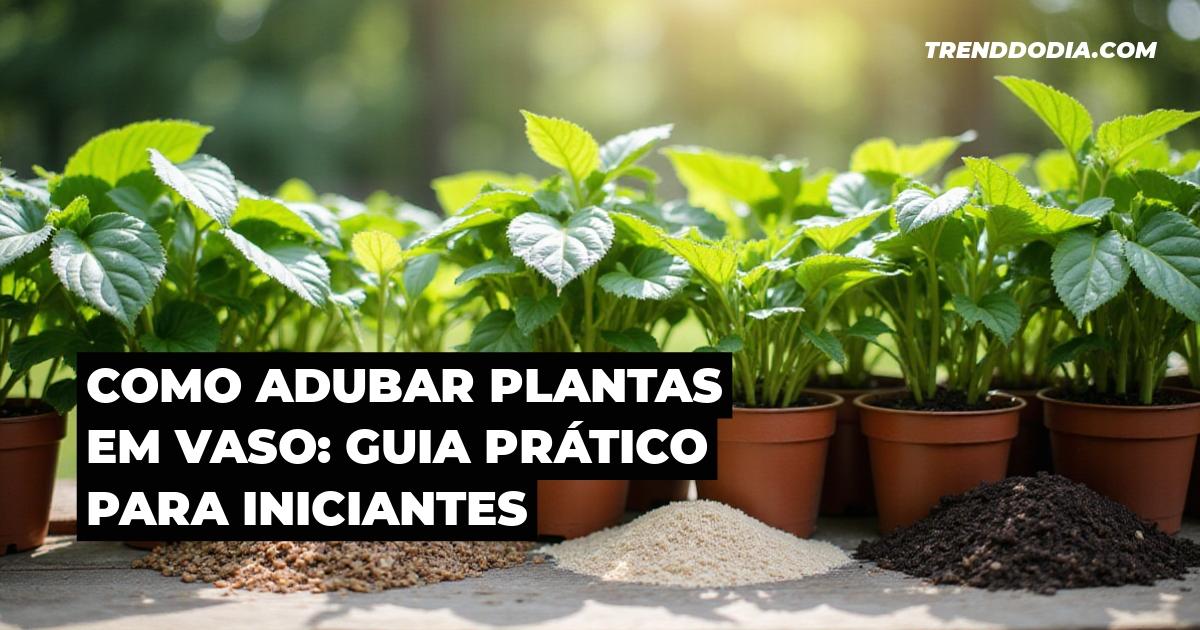
To fertilize potted plants, you choose the fertilizer that suits them, whether organic, NPK or homemade, measure the right amount for the size of the pot, always apply it to moist soil and repeat every 15 to 45 days, adjusting according to the type of plant and the season.
If you've ever tried to grow plants and run into trouble, like burning one with fertilizer that was too strong or not noticing any difference at all, you probably got the dosage, the type of fertilizer wrong, or the timing of the application wrong. Let's go through a step-by-step guide with practical tips so you can take care of your potted plants with peace of mind and watch them grow healthy.
Why do potted plants need fertilizer more often?
Have you ever noticed how potted plants stop growing or end up with yellowing leaves? This happens because the limited space in pots depletes the substrate's nutrients very quickly, requiring more frequent fertilization.
In pots, nutrients disappear 2 to 3 times faster than in a garden, according to data from 2023 urban cultivation technical guides. Therefore, those who care for plants in apartments with multiple pots should be aware of this.
In their daily lives, those who have plants like this also need to take care of other basic details, in addition to fertilization, such as that supplementary reading on general care that makes everything easier.
Difference between potted plants and plants in the ground.
Plants in the ground absorb mineral nutrients from the natural soil and organic matter that decomposes over time. But those in pots depend solely on what you put in them, without automatic renewal.
This dependency means that potted plants require more frequent maintenance. Think of a tree in the garden that takes care of itself, versus a potted tree that relies on you to replenish what it needs.
Signs that your pot needs fertilizer.
Yellowing leaves or slow growth indicate a lack of nutrients. Also look for roots coming out of the drainage hole, a sign that the plant is seeking more than the pot can provide.
At times like these, it's time to think about fertilization. A healthy plant, without flowers or with weak leaves, confirms that something is wrong with the substrate.
When to fertilize potted plants: frequency by season.
The frequency changes with the climate, as plants grow more in the heat and slow down in the cold. In summer, fertilize every 15-20 days; in winter, increase this to every 45-60 days to avoid over-fertilizing.
Brazilian gardening manuals from 2024 show that, in spring and summer, many species enter an active growth phase, using up to twice as many nutrients compared to winter. Therefore, you adjust accordingly to their needs.
In these cases, fertilization goes hand in hand with proper watering, and that additional reading about water frequency and quantity is worthwhile for anyone who wants to succeed.
Simple fertilization calendar for the Brazilian climate.
In Brazil, the seasons are taken into account: from September to March (autumn to spring in the southern hemisphere), fertilize monthly. In spring/summer (December to March), increase to every two weeks.
Consider that in places like São Paulo, with its hot spring and summer, more application is needed. Conversely, in the milder winters of the Northeast, reduce the amount needed to adjust to the temperature drop.
Can I fertilize in the winter?
Yes, but in smaller doses and less frequently, since plants slow down in the cold. This prevents burning roots or forcing weak growth that cannot withstand frost.
During these cooler days, focus on lightweight organic fertilizers. If you live in a place with harsh winters, like Florianópolis, wait for signs of growth in the leaves before taking action.
What types of fertilizer should I use for potted plants?
There are three main categories: organic (from natural matter), chemical (NPK type), and mixed (a combination of both). Each has its advantages; organic fertilizers are released slowly and are safe, while chemical fertilizers act quickly, but be careful not to overdo it.
Liquid fertilizers mix with water, ideal for watering; granules stay on top of the soil and are released gradually. Forget the idea that one is better than the other: it depends on your plant.
A 2024 market report on the gardening industry shows growth of approximately 101% per year in organic products for home gardens and vegetable patches. As a result, they are becoming increasingly easy to find in stores.
When we talk about organic fertilizers and homemade compost for potted plants, think of that option for those who want to make their own fertilizer and give it that extra boost.
Organic: humus, manure, and castor bean cake.
Worm humus is great for potted foliage plants, as it's full of valuable organic matter. Well-rotted manure prevents sunburn and provides gradual nourishment.
Castor bean cake works well on larger plants, such as fruit trees. They all release nutrients gradually, perfect for those who value sustainability.
Chemical and mixed: NPK, sticks, and liquid fertilizers.
NPK is balanced in nitrogen, phosphorus, and potassium; use it for general growth. The sticks go into the soil and last for months, simple as that.
The liquids come ready to dilute when watering. They have quick effects, but be careful with the dosage to avoid overdoing it.
Step-by-step guide to fertilizing any potted plant.
First, thoroughly moisten the soil. Spread the compost on top, away from the stem. Cover lightly with soil and water lightly to incorporate everything.
A technical guide to home fertilization published in 2023 indicates that most problems with burning roots in pots are related to application in dry soil. In everyday practice, the same step-by-step process applies to pots with herbs and vegetables, and more detailed reading about vegetable gardens is very helpful.
Observe for a week: if it improves, you're on the right track; if it worsens, reduce the dose next week.
How to apply granular fertilizer without burning the roots.
Dig a shallow hole around the plant. Place the granules there and cover it immediately. Never directly on the stem, okay?
By baking, the roots absorb the product without too much direct contact. Always wet it beforehand to activate it, understand?
How to use liquid fertilizer and fertigation
Dilute according to the instructions in clean water. Use in place of normal watering, watering slowly to avoid overflowing.
Fertigation combines water and nutrients in one step. Ideal for those with busy schedules.
How much fertilizer should I use for each pot size?
Small pots (15-20 cm) need 1-2 teaspoons; medium pots (25-35 cm), 2-3; large pots (over 40 cm), 4-5 times that amount. Always dilute if it's liquid.
Practical home gardening manuals from 2024 use an average of 4 grams of granular fertilizer per teaspoon as a basis for dosage calculations. Sometimes, it's not just about increasing the fertilizer, but also renewing the substrate, and that suggestion about changing the soil complements the care well.
Too much burns the roots; too little weakens them. Adjust it for more sensitive plants, right?
Quick guide to measurements for small, medium, and large pots.
Small: half a teaspoon at a time. Medium: one heaping teaspoon. Large: two teaspoons or more.
Then, multiply that by the nutrients your plant needs. Try it with a small amount and watch the results appear.
Dosage adjustments for sensitive plants such as succulents and cacti.
Sensitive plants like succulents reject strong fertilizers. Use half the normal dose and fertilize only every 2-3 months.
With these products, be careful not to damage the delicate roots. Opt for lightweight, straightforward organic products.
Safe homemade fertilizers for pots (without overdoing it)
Coffee grounds provide nitrogen without burning. Eggshells provide calcium. Vegetable water is a natural source of potassium like few others.
Municipal environmental education campaigns in 2024 show growing interest in reusing organic waste at home as compost, especially in large capital cities. Those who produce compost at home to use in their pots see that reinforcement from the link as a step-by-step guide to get started.
The secret is not to overdo it: apply it diluted and spaced out, it's that simple.
How to use coffee grounds, eggshells, and vegetable water.
Mix coffee grounds on top of the soil once a month. Crush eggshells and sprinkle them around the edges, no problem.
Water with filtered vegetable water every fifteen days. Make sure it doesn't contain salt or spices.
Be careful not to overdo it with homemade fertilizer.
Keep an eye on the roots; dry, soil-based roots accumulate salts. Use sparingly and observe reactions for several days.
If it went well, keep going; if not, wash the toilet and reduce the amount of water, okay?
Extra care: common mistakes and examples by plant type
Common mistake: applying fertilizer to dry soil. Avoid high doses the first time. Always test first, understand?
Urban gardening guides published in 2023 indicate that the most common mistake in fertilizing potted plants is over-fertilizing, not under-fertilizing. When it comes to potted vegetables and herbs, such as basil, chives, and lettuce, that suggestion for specific details on fertilizing a garden is very relevant.
For plants like lemon trees, prioritize phosphorus; for flowers, nitrogen is more important. Soil tests reveal clear preferences.
In these cases, note any changes after fertilizing. Flowers appearing indicate that it worked, right?
Common mistakes when fertilizing potted plants and how to avoid them.
Changing frequencies too frequently is detrimental; ignoring the season means forgetting the natural rhythm. So, use notes from the plantation, just look.
But, observe the plant's signals before acting without thinking too much.
Practical examples for fruit trees, flowers and foliage.
Lemon trees turn yellow without NK; flowers wither without potassium. Foliage grows slowly without the right mix.
Consider this example: a boa constrictor recovers with well-applied, balanced humus, and that's it.
To emphasize, fertilizing potted plants involves choosing the right type of fertilizer (organic, chemical, or homemade), respecting the dosage for the size of the pot, always applying it to moist soil, adjusting the frequency according to the season and the plant, and observing the response of the leaves, roots, and flowers.
Encourage the reader to test a simple fertilization plan over the next 30 days in at least one pot, note the results (more leaves, flowers, scent), and leave comments with questions or homemade tricks that worked at home.